Sunday, September 26, 2010

Astrophotography for 2010 with Update

Update: On October 8, I set up on my deck again to view Jupiter, and I was able to see Jupiter AND all 4 of its moons:


The year 2010 has been a good year for taking pictures of the stars and planets.

I have accepted that I live in an urban setting just west of Washington DC--and that I live in a sort of 'hole', with no access to the horizon for good sun rise/moon rise or good sun set/moon set. Light pollution is prevalent in the north and easterly direction, often extending from the horizon to 30 degrees above the horizon--independent of any moisture in the air, creating haze.

The collection of pictures you'll see were all taken in my neighborhood--primarily from my backyard deck but also from the street out front.

My typical equipment setup is a Manfrotto carbon fiber tripod, a Kirk Enterprises ball head, a Canon T1i digital SLR running at higher ISO's (800 - 6400), 1.4 and 2x Kenko Extenders, and a Canon 300mm lens for long shots and a Canon 17 - 85mm lens for wide angle views.

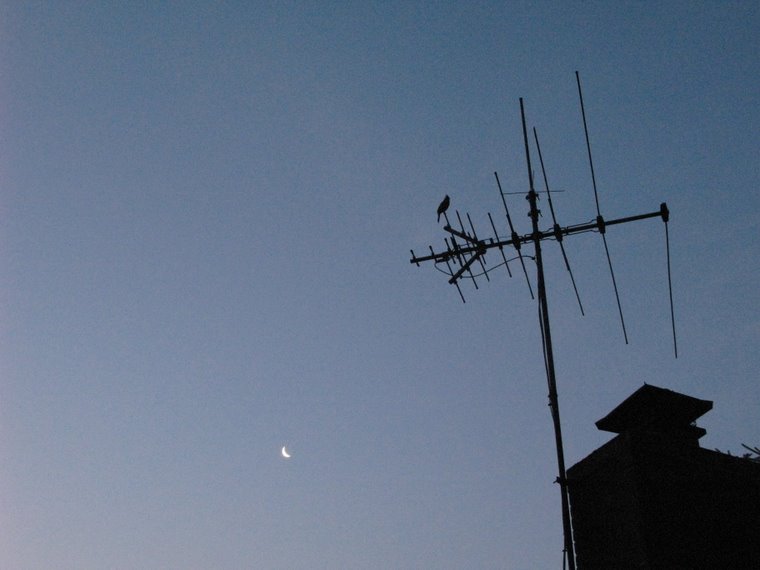
Near the spring equinox in March, I captured a crescent moon:


The next major stellar event occurred in late June and early July, when Venus, the star Regulus, Mars, and Saturn all lined up, from low in the NW sky to higher in the Western Sky. Later in July (I checked on the 15th), this line was broken and no longer straight.

My western skies view is blocked by backkyard trees that have grown over the years. After walking around the neighborhood for several blocks to find a good view, I realized that my next door neighboor had a full view of the western sky. So, on the 4th of July--while neighborhood fireworks were being set off--I set up my camera in his back yard and fought off the gnats and mosquitoes during the ~ 20 second multiple exposures. This is what I go to see:


From L to R, Saturn, Mars, Regulus, and Venus

In late August, I had a great view of the Big Dipper from my front yard. Normally I don't look for the Big Dipper until winter, but since the view was there and there was some visibility, I decided to shoot it. Note how the camera and lens were able to resolve the double star in the Big Dippers' star that is second from the end of the handle.


In a series of four consecutive pictures, I discovered some type of "sky object" that looks like a comet and moves towards the NW as it dissipates. I checked in Starry Night Pro, it showed nor indicated any space objects--so I guess it was something man-made.

     Open up this image and then look towards the center of the top to see a yellowish object.


On Thursday night the 23rd of September, I took advantage of a moon one day past Harvest State with a good view of Jupiter from my deck. I used my 300mm lens with the 2x extender plus Live View 10x to manually focus on Jupiter. Tonight only 3 out of the 4 moons were showing; the 4th was behind Jupiter itself.


     The bonus for the night was that Uranus was also evident--a planet I thought I'd never be able to see! With my birding binoculars, I could see Uranus slightly above and to the left; Uranus appears as a fuzzy blue blob in the sky. I over-exposed Jupiter in order to capture Uranus.

     Open up the image to see Uranus at the upper left.


      There are three upcoming meteor showers left for the year:  late October, mid-November, and mid-December. I hope to load up my RV with chairs, warm beverages, and cameras with extra batteries and drive up to Skyline Drive in Shenandoah National Park and stay at an overlook--perhaps Stony Man--and watch the meteor shower through the night--at least that is the plan!

Sunday, May 2, 2010

Update to Kenko Extension Tube Use

On Saturday, I decided to visit a neighbor who is a flower gardener--I love to visit her garden.

I decided to see what the affect would be on inserting a 12mm Kenko Extension Tube between the body of my Canon Rebel T1i and my Canon 17 - 85mm EF-S lens. This normally has a macro distance of ~8" to 18".

I found a violet "puffball" flower of approximately 3" in diameter and attempted to take a picture of it. I was unable to do so except under this condition:
  • 17mm wide open, almost on top of the object (less than 0.5cm)--with no further magnification allowed. Any other scenario was totally blurred.

I'll continue to use my extension tubes with the longer 55mm - 250mm and 300mm lens--for which the tubes were really designed for.

Saturday, January 23, 2010

January 23 2010: Experiment with Kenko Extension Tubes

For several years, I have been curious about the use of Extension Tubes. Arthur Morris in his Birds As Art bulletins has used Extension Tubes with his telephoto lenses, occasionally with a teleconverter added to the stack.

For Christmas, I purchased a set of Kenko Extension Tubes in these sizes: 12mm, 20mm, and 36mm. These are straight tubes, with no glass or optics inside. They have the connections to allow for your AF functions to still work. I conducted an experiment to see what the effects and benefits were to their use. I used these sizes individually; they may be stacked for additional gain. I wanted to see how I might be able to use this lens for macro work.

Conditions: Canon Rebel Xsi body with a Canon 55 - 250mm IS EF-S lens on a tripod. I set the focal length to 100mm. Aperture was fixed at f/6.3. ISO = 800. Using ambient lighting from a nearby lamp. Used a 2 second delay to take the picture. Note, the closest distance to an object in this scenario is 1.1m or 3.6 feet. I used a Christmas ornament as my object.

Initial findings: as you increase the length of the tube and move closer to the object, you get an increased object size in exchange for requiring a longer shutter speed (less light).

This first shot is taken with no extension tube. Aperture is f/6.3 and shutter is 1/40 sec, and the distance from the hot shoe to the front of the object is 43.5".


This second shot is with the 12mm extension tube. Aperture is f/6.3, and the shutter is at 1/25 sec. The distance from hot shoe to object is now 39". Can't really see a benefit or improvement in object size.


This shot is taken with the 20mm extension tube. The aperture is f/6.3, and the shutter is now 1/20 sec. The distance from hot shoe to front of object is now 27". Note the signficant improvement in object size.


This shot is taken with the 36mm extension tube. Aperture is f/6.3, and the shutter speed is 1/8 sec. Note the greatly magnified object size. Distance from hot shoe to front of object is now just 18", compared to the earlier 43.5" with no tube.
Conclusion: Assuming that I have good lighting and possibly a tripod, I can use this technique to magnify object sizes. Note, that with extension tubes, they will fit my other telephoto lenses--unlike magnifiers placed on the front of the lens, which must match the size of the lens filter.
Next experiment will be with my 30mm lens, with and without a 1.4 teleconverter to see the benefits and restrictions of this combination.


Dec 14 2009: Green Spring Garden Park, Alexandria, va.

Green Spring Garden Park in Alexandria, Va., is one of my favorite places to take pictures. This Fairfax County Park strives to have flowers and plants growing and visible year round. If freezing has already occurred, the greenhouse on the premises is also available.

I decided to pack my camera and stop by this Park on my way to work. These are the highlights of what I saw 10 days before Christmas. It was sunny with a light breeze. I stayed for about 30 minutes. Next time I'll check out the stream below.

I love the bright red pyracantha, with the old country house in the background.

A winter cabbage with last night's rain having beaded up.

A few berries are in bloom here.
Even with a recent freeze, this plant was reasonably intact.

I like the water droplets on this frozen rose.

I love "explosions in nature"

Another cabbage

I particularly like the texture and color of these leaves.
I like the look of grasses

More flowing, wispy grasses

Sunday, November 15, 2009

Blue Ridge Parkway Mid-Sept 2009

My wife and I pointed our RV down the Blue Ridge Parkway, starting at MP Zero, Rockfish Gap/ Afton Mountain in Va., just past the end of Skyline Drive in the Shenandoah National Park, and heading south.

We camped at a succession of National Park campgrounds: Otter Creek, Peaks of Otter, and Roanoke Mountain. We thoroughly enjoyed the regional cooking served up at the Otter Creek restaurant and the lodge at the Peaks of Otter.

Below the Peaks of Otter put prior to Roanoke Mountain, we watched the Broad-Wing Hawk migration at Harvey's Knob, a well known hawk observatory in the area. We saw over a hundred broad wing hawks in an hour, starting at noon. The sky was too hazy to get a really good photograph of the swirling hawks. We did look for hawks at the Afton Mountain hawk watch site, but none were evident at that time.

The weather was balmy, 60 - 70 by day, and the 50's at night, requiring the furnace to turn on.

In the extreme uphill climb from the James River Visitor's Center--the lowest point on the Parkway to the Peaks of Otter via Apple Orchard Mountain (highest point on Parkway in Va.), we met a couple named Bob and Christina from the Research Triangle area of NC who were biking from Front Royal (start of Skyline Drive) in Va. to Mt Mitchell in NC, the highest point in North Carolina, a distance of 480 miles. We were able to provide them with some extra water as they steadily biked uphill.

This is a view of Otter Creek, passing under the Parkway

At Otter Creek Lake, we found two butterflies very attracted to a piece of apparently white bread.
Nearby, we found another, different butterfly
This dragonfly presented itself above the water's edge

This unusual butterfly was just sitting on the side of a nearby structure

While walking around Abbot Lake (Peaks of Otter Lodge), a very curious deer came over to see me. Her ears perked up when I spoke to her.


Near the Peaks of Otter, we discovered some thistle in bloom, attracting both bees and butterflies

On the fringe of Abbot Lake, I found these plants growing at the water's edge


The spiders were quite active at the Otter Creek Campground


An interesting pair of stumps


Some wildflowers at Otter Creek


A small collection of wildflowers not far from the creek


Along the Otter Creek Trail, I spied a spider's web


Some person(s) with a sense of humor stacked rocks on top of each other in Otter Creek. This recurred over a distance of half a mile


The Parkway offers up a fascinating variety of lichens and ferns, particularly north and south of Otter Creek.


More lichen with yellow wildflowers
This is a view of the James River Water Gap, with the James River Face Wilderness in the mountains there--along with the Appalachian Trail
This bridge underpass is accessible from the James River Visitor's Center. The US Highway passes overhead; this path will take you to a set of old locks

A short trail from the Visitor's Center passes by these rocks on the way to a view of the Water Gap


Just outside the Visitor's Center, some of the stone were deliberately set to resemble a buffaloe


Before the advent of the railroads and their progress to the Blue Ridge Mountains from Richmond, the James and Kanawha Canal paralleled the James River. This is one of the lock control mechanisms
This is a more complete view of a lock


These wildflowers were just above the locks


Adjacent wildflowers

A set of pretty yellow wildflowers, with the mountains by Buchanan in the background. James River bottom land in the foreground

Wildflowers seen on the Parkway
A view from the north of the Peaks of Otter


I see this flowering plant up on Skyline Drive, too

Bob and Christina, on their way to Mt Mitchell in NC

We stopped at an overlook called Thunder Ridge. These wildflowers were on the walkway to the overlook


This wildflowere really caught my attention, with the white and yellow together
A caterpillar enjoying this plant


More wildflowers enroute to overlook
While registering at the Peaks of Otter Campground, this deer came over to see us. When my wife talked to her--for several minutes--her ears perked up!

While walking along the lake (Abbot) trail, I saw these berries growing along the path

View of the lodge rooms, which all face Abbot Lake and Sharp Top Mountain. The tall mountain behind is called Mourning Hill


Sharp Top rising above Abbot Lake

At dusk and using ISO 6400 handheld, I captured this thistle on the Lake Trail
One more deer browsing along the Lake Trail; she was watching me carefully