Saturday, March 26, 2011

March 19 2011 Supermoon Viewing

This was a perfect night to view the Supermoon--the closest the full moon was for the last 18 years! The trees near the horizon were leafless, and the temperature was mild.

My wife set me up with a spectacular viewing set-up:  a pair of Oberwerk 15 x 70 big binoculars on a Universal Astronomics tripod and parallelogram-balanced viewing assembly--which means I could view the moon for minutes at a time effortlessly instead of just for seconds hand held.

Add to this a special reclining chair meant for sky watching, and it doesn't get any better than this! Below is the setup on my deck!


From my Canon DSLR on a tripod with a 300mm lens with a 2x extender, I was able to capture this image!


Finally, while I was walking my dog and carrying a small Canon point and shoot camera, I took this handheld shot just to show that I did I see this moon in its "Great Pumpkin" mode:


Saturday, January 1, 2011

Dec 31 2010: Walk around Hidden Pond Nature Center Park


Every year right around New Year I visit a local park to check out the birds, plants, water and ice, and whatever else is evident.

This year I chose Hidden Pond Nature Center, a park less than two miles away--part of the Fairfax County (Va.) park system.

Today, the temperature was in the low 50's--quite balmy for the end of December. I started at the Nature Center and then wandered around the various trails, finishing at the caretaker's home.

This white breasted nuthatch was moving quickly along a tree along the perimeter of the pond--I was fortunate to catch this view of it!

Two items of note:  I experimented with a Canon Power Shot SD 4000 IS Digital Elyph camera for the first time--Steve Ingraham recommends it for use with Zeiss spotting scopes; I thought I'd give it a try in a conventional manner. Second, I wore a pair of NEOS overshoes through the muddy trails--these were a Christmas present from my wife. These are awesome! Excellent tread; they fit over my regular shoes--and are waterproof, as high as below my knee. There'll be a picture below.

This white breasted nuthatch was moving quickly along a tree along the perimeter of the pond--I was fortunate to catch this view of it!


This tufted titmouse was the next bird I saw.

The pond was slightly frozen and snow covered.


I found several patterns that caught my attention:


When I walked the trails and stream below the pond, I came across ice:

Crystals:


A nice ice block:


Finally, a faux ice floe:


A spillway below the pond provided me with some nice images:

I particularly like the pattern just upstream of the drop:


There were interesting dead wood and reflections in the pond:


The next one makes me think about a small petrified dinosaur:


I found some dried leaves that caught my attention:


It was so warm that even a small bee came out to some grasses that were in the sunlight:


 My Powershot SD 4000 camera has an interesting feature:  built-in means to create fish-eye lens effect.

I first tried it on the pond:


Then I tried it on a large picnic table--before:


and after:


The neat NEOS Overshoes, acquired through Arthus Morris' on-line store--great for getting around in marshes, muddy trails, and fording small streams--a great Christmas present from my wife! Note the velcro flap enclosures running the length of the overshoe!


  I visited the caretaker's cottage--and I saw that someone had a sense of humor:  I saw a half dozen pair of boot and sneakers thrown over tree limbs in the back yard--this is one of six!


Finally, here is what the sky looked like when I started into the park--a glorious day!

Friday, November 26, 2010

November 21 2010 Appalachian Trail, Greenbrier State Park to Annapolis and Black Rocks, Md.

My sister and are re-starting out hiking adventures again--the last one was on the A-Trail in Md. from Washington Monument State Park to Greenbrier State Park and return.

So we drove to Greenbrier State Park just outside of Boonsboro, Md., off of US Rt 40, the old National Pike. It was a nice day for November:  low 50's at the height of the day with winds along the ridge and little wind down below. Link to description of the features of the Greenbrier State Park

The Visitor Center had just opened, and we were able to talk to the ranger there about the trails and pick up a map. We started the trip hiking up the steep Bartram Hill Trail connector to the A-Trail. The Bartram is well blazed but completely filled with leaves, which hid the trail.

From this sign, we could see that we were somewhere close to the middle of the A-Trail. 40 miles of it runs through Md.

My sister Amy


We had two destinations as we headed north:  a local attraction called the Annapolis Rock and then a little further, Black Rock. The total round trip distance for our hiking was 9.25 miles--quite a nice hike!

View of covered path over I-70
 The general area we were hiking on was generally called South Mountain.


The National Road crossed over I-70 and also provided an alternate trail head to begin the hike:


The trail is wide and well maintained. We encountered several Boy Scout groups and a number of families. A number of happy dogs were also out and about. The most interesting one was a young pit bull, who carried an 8' log in her mouth as she went up the trail. At her owner's request, she willingly dropped it as she approached us.

When we got to Annapolis Rock, several people were setting up their ropes to repel down.

Nice view of the rock out croppings
While this location provided a view of both Greenbrier State Park (and its lake) plus the Cumberland Valley to the west, the skies were hazy:


A mile beyond Annapolis Rock to the north, we came to Black Rock. This was a great place to have our lunch.


After lunch, we hiked back to our car without a break, traveling just over 4.5 miles in two hours. Going south was mostly downhill, so it was easier.

Next spring we are thinking about hiking from Gathland State Park just to the south to Weverton Cliffs, a setting just prior to descending down to Harper's Ferry, WV.

Thursday, October 28, 2010

Late October 2010 Trip to Pearland, Texas

My wife and I drove down to Pearland Tx., just south of Houston, to see our daughter.

She lives in a planned community (Shadow Creek Ranch)--which has miles and miles of paved multi-use walking trails and paths. The big bonus? Shorebirds!

The neighborhoods have many flood control waterways, which now have tall marsh grasses and water, perfect for year round and possibly migratory birds.

While there for several days, I saw White Ibis, Great and White Egrets, Great and Blue Heron, Killdeer, a plover-like bird, dark ducks, mockingbirds, red birds, and even a pair of osprey. These are the types of birds I associate with driving to Virginia and Maryland's Eastern Shore! And this for walking just 5 - 10 minutes!


The killdeer squacked until late at night

Little Egret in flight


Egret departing; Ibis arriving

Great Blue Heron with two Ibis--one Ibis has a dark shellfish in its mouth!
 
Killdeer

Plover-like bird

Great White Heron


Egret in flight--urban setting!
 

Two ducks visiting

Egret and many Ibis feeding together

Little Blue Heron with a Great White Heron

Egret in flight


Urban setting--in flight

I can't wait to go back!


Sunday, September 26, 2010

Astrophotography for 2010 with Update

Update: On October 8, I set up on my deck again to view Jupiter, and I was able to see Jupiter AND all 4 of its moons:


The year 2010 has been a good year for taking pictures of the stars and planets.

I have accepted that I live in an urban setting just west of Washington DC--and that I live in a sort of 'hole', with no access to the horizon for good sun rise/moon rise or good sun set/moon set. Light pollution is prevalent in the north and easterly direction, often extending from the horizon to 30 degrees above the horizon--independent of any moisture in the air, creating haze.

The collection of pictures you'll see were all taken in my neighborhood--primarily from my backyard deck but also from the street out front.

My typical equipment setup is a Manfrotto carbon fiber tripod, a Kirk Enterprises ball head, a Canon T1i digital SLR running at higher ISO's (800 - 6400), 1.4 and 2x Kenko Extenders, and a Canon 300mm lens for long shots and a Canon 17 - 85mm lens for wide angle views.

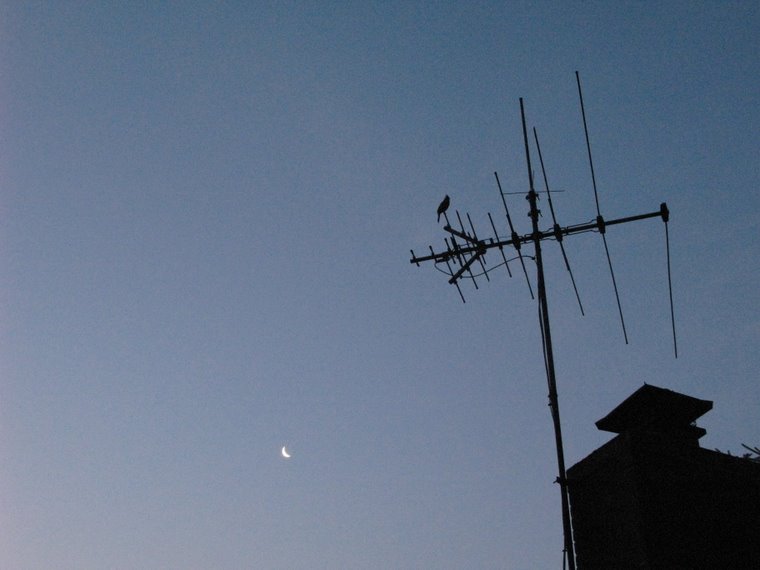
Near the spring equinox in March, I captured a crescent moon:


The next major stellar event occurred in late June and early July, when Venus, the star Regulus, Mars, and Saturn all lined up, from low in the NW sky to higher in the Western Sky. Later in July (I checked on the 15th), this line was broken and no longer straight.

My western skies view is blocked by backkyard trees that have grown over the years. After walking around the neighborhood for several blocks to find a good view, I realized that my next door neighboor had a full view of the western sky. So, on the 4th of July--while neighborhood fireworks were being set off--I set up my camera in his back yard and fought off the gnats and mosquitoes during the ~ 20 second multiple exposures. This is what I go to see:


From L to R, Saturn, Mars, Regulus, and Venus

In late August, I had a great view of the Big Dipper from my front yard. Normally I don't look for the Big Dipper until winter, but since the view was there and there was some visibility, I decided to shoot it. Note how the camera and lens were able to resolve the double star in the Big Dippers' star that is second from the end of the handle.


In a series of four consecutive pictures, I discovered some type of "sky object" that looks like a comet and moves towards the NW as it dissipates. I checked in Starry Night Pro, it showed nor indicated any space objects--so I guess it was something man-made.

     Open up this image and then look towards the center of the top to see a yellowish object.


On Thursday night the 23rd of September, I took advantage of a moon one day past Harvest State with a good view of Jupiter from my deck. I used my 300mm lens with the 2x extender plus Live View 10x to manually focus on Jupiter. Tonight only 3 out of the 4 moons were showing; the 4th was behind Jupiter itself.


     The bonus for the night was that Uranus was also evident--a planet I thought I'd never be able to see! With my birding binoculars, I could see Uranus slightly above and to the left; Uranus appears as a fuzzy blue blob in the sky. I over-exposed Jupiter in order to capture Uranus.

     Open up the image to see Uranus at the upper left.


      There are three upcoming meteor showers left for the year:  late October, mid-November, and mid-December. I hope to load up my RV with chairs, warm beverages, and cameras with extra batteries and drive up to Skyline Drive in Shenandoah National Park and stay at an overlook--perhaps Stony Man--and watch the meteor shower through the night--at least that is the plan!